If there is one style of home that defines Long Beach more than any other, it is the California Craftsman bungalow. Named by This Old House as one of the nation's Best Old House Neighborhoods in 2012, Rose Park in Long Beach was celebrated for exactly this reason — blocks of well-preserved Craftsman homes with genuine community character and architectural soul. That recognition was not a surprise to anyone who works in this market. Craftsman bungalows have been the backbone of Long Beach's historic residential neighborhoods for over a century, and they remain among the most consistently sought-after homes in the city today.
What Is the California Craftsman Bungalow?
The Craftsman movement was born as a direct reaction against industrial mass production. It was the early 1900s — roughly 1905 through the late 1920s — and architects and builders in the Arts and Crafts tradition wanted homes that were honest, handmade, and connected to the natural world. Simple but beautiful. Functional but deeply considered. The California bungalow was the West Coast expression of that philosophy, and it became one of the most successful residential building movements in American history.
The style was so widely embraced that Sears, Roebuck and Company sold complete Craftsman homes as mail-order kits from their catalog. Families ordered them, received the lumber and hardware by rail, and built them with their own hands or with local contractors. The result was a beautifully designed home available to middle-class families across the country — a democratic architecture that believed craftsmanship should not be reserved for the wealthy. That spirit of accessibility and quality is still palpable when you walk through a well-preserved example today.
The Six Defining Features of Craftsman Architecture
Understanding these features matters whether you are buying, selling, or simply trying to identify what you are looking at when you drive through Belmont Heights or Rose Park.
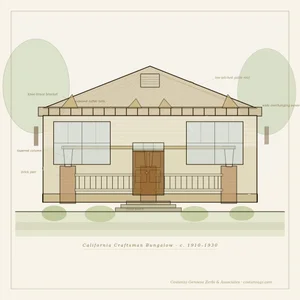
Low-pitched gabled roof with wide overhanging eaves. The roofline is one of the first things you see. Low, horizontal, with broad overhangs that shade the walls and the porch from the California sun. This was practical design — the overhangs reduced heat gain and protected the wood siding from rain — but it is also the visual signature that makes a Craftsman immediately recognizable from the street.
Exposed rafter tails. Look up under those overhanging eaves. In a true Craftsman, you can see the ends of the rafters — the structural members — left exposed and visible. This is the philosophy made visible: the architecture does not hide its construction. It celebrates it. Exposed rafter tails are one of the details that serious buyers look for when evaluating authenticity.
Decorative knee braces and brackets. The brackets and knee braces under the eaves and at the gable ends are both structural and ornamental. In high-quality examples they are substantial, carefully detailed, and a significant part of the home's character. Simplified or replaced versions are immediately noticeable to a knowledgeable buyer.
The front porch — always. A Craftsman without a front porch is not fully a Craftsman. The porch is the transitional space between the home and the street, designed for sitting, for community, for the California evening. Tapered columns on brick or stone piers are the classic porch detail — wider at the base, narrower at the top — and they are one of the most distinctive and beloved elements of the style.
Natural materials throughout. Wood siding, brick piers, river rock, stone — used honestly and without artifice. The Craftsman philosophy held that natural materials should be expressed as what they are, not painted over or concealed. Original wood siding, original brick, and original stone piers are valuable assets in a listing.
Built-in cabinetry and interior woodwork. Step inside a well-preserved Craftsman and the interior is as considered as the exterior. Built-in bookshelves flanking a fireplace. Plate rails running along the dining room walls. Window seats. Beamed ceilings. Wide-plank floors. The woodwork is warm, purposeful, and the feature most buyers describe when they explain why they fell in love with the home.
The Architects Behind the Style
While the California bungalow became widespread through pattern books and mail-order catalogs, two architects elevated it to an art form: Charles Sumner Greene and Henry Mather Greene, working together as Greene and Greene in Pasadena.
Their masterworks — including the Gamble House in Pasadena, completed in 1908 — represent the highest expression of the Craftsman ideal. Every joint expressed, every piece of wood carefully selected, every detail considered in relation to the whole. The Gamble House is now a National Historic Landmark and one of the most significant residential buildings in American architecture.
You do not need to own a Greene and Greene masterwork to benefit from the architectural legacy they established. Their influence shaped the entire vocabulary of the California bungalow, and the principles they brought to their finest work — honesty of materials, integration of interior and exterior, respect for craftsmanship — are present in even the modest examples that line the streets of Rose Park and Carroll Park in Long Beach.
Where to Find Craftsman Bungalows in Our Market
Long Beach
Long Beach has the densest concentration of well-preserved Craftsman bungalows in the region, distributed across several historic districts that offer both city protection and a proven track record of appreciation.
Belmont Heights is perhaps the most celebrated. The neighborhood holds hundreds of Craftsman bungalows alongside Spanish Colonial Revival and other period styles, most built between 1910 and 1930. The streets are tree-lined, the lots generous, and the neighborhood association active. It is one of the most desirable historic residential areas in the city.
Rose Park — which This Old House recognized as one of the nation's Best Old House Neighborhoods — is centered around a small circular park at Orizaba and 8th Street and extends outward through blocks of intact Craftsman homes. It borders Retro Row on 4th Street, giving residents walkable access to Long Beach's most vibrant commercial corridor. Rose Park and Rose Park South together form one of Long Beach's largest historic areas.
Bluff Heights sits between Broadway and 4th Street and is home to some of the most intact Craftsman bungalows in the city, most built between 1910 and 1923. The neighborhood is steps from the beach and from Retro Row, and its historic designation has helped preserve the architectural character that makes it one of the most competitive markets in Long Beach for single-family homes.
Carroll Park is the quieter, slightly more affordable cousin to Bluff Heights — a historic district with curving streets, landscaped islands, and beautifully preserved bungalows. It has been one of the quietly appreciating neighborhoods in central Long Beach, attracting buyers who want the Bluff Heights experience with a slightly softer entry point.
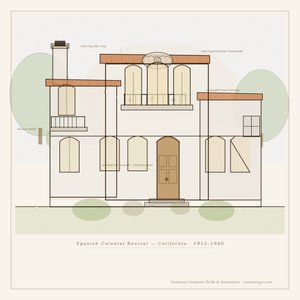
California Heights, while primarily known for its Spanish Colonial Revival homes, also contains significant Craftsman examples alongside its 1,500 period homes. As Long Beach's largest historic district, it offers protection and community identity that few neighborhoods in the city can match.
Los Angeles
Highland Park is the center of gravity for Craftsman homes in Los Angeles proper. The neighborhood experienced a well-documented revival over the past decade as buyers and preservationists recognized the quality of its housing stock — blocks of intact bungalows that had been largely untouched. The California Bungalow Foundation maintains an active presence in the community.
Pasadena holds the finest examples of the style anywhere in the country, including the Gamble House. Beyond the landmark buildings, the residential neighborhoods near Old Town and the Huntington Library contain blocks of exceptional Craftsman homes.
Altadena, just north of Pasadena, has a significant and relatively intact Craftsman stock at price points that have historically been more accessible than the Pasadena market. It has attracted buyers who want architectural quality and neighborhood character without the full Pasadena premium.
Echo Park and Silver Lake also have notable concentrations, particularly of the smaller, more urban bungalow court typology — multiple bungalows arranged around a shared courtyard, a California invention that combined the Craftsman ideal with the density demands of early 20th-century urban development.
Why Original Condition Matters More Than You Think
The buyer for a California Craftsman bungalow is one of the most architecturally literate buyers in the residential market. They know the style, they know the features, and they can see immediately whether what they are looking at is authentic or a version that has been updated in ways that dilute the original character.
Here is what that means practically for sellers:
Original wood siding is worth more than replaced siding, even if the original needs repainting. Original single-pane wood windows with divided lights are often worth more than replacement double-pane units that have removed the divided light pattern. Original built-in cabinetry — even if it needs refinishing — is worth significantly more than a kitchen renovation that removed it for a more contemporary look. Original brick porch piers are worth preserving at nearly any cost; replacing them with concrete or simplified reproductions is immediately visible and always a value reduction.
This does not mean you should never update a Craftsman before selling. It means the updates should enhance rather than erase. Refinishing hardwood floors, repainting interior woodwork, updating fixtures while preserving the architectural shell, restoring rather than replacing — these are the improvements that add value in this buyer pool.
The wrong renovation permanently removes something that cannot be put back. The right approach preserves what matters and presents it well.
Historic District Designation: What It Means for Your Value
Several of the Long Beach neighborhoods where Craftsman bungalows concentrate — Belmont Heights, Rose Park, Bluff Heights, Carroll Park, California Heights — carry city historic district designation. This is worth understanding as a seller.
Historic designation means the neighborhood's architectural character is legally protected. Owners cannot demolish contributing structures or make significant exterior alterations that diminish historic character without city approval. For buyers, that protection is confirmation that what they are buying into — the tree-lined streets, the intact bungalows, the neighborhood identity — is permanent. They are not buying next to a neighbor who could tear down a Craftsman and build a three-story contemporary tomorrow.
That permanence is a pricing floor. Historic designation consistently supports values in down markets because the supply of authentic examples cannot increase — it can only decrease. Every poorly renovated or demolished contributing structure makes the remaining intact examples more valuable.
If you own a Craftsman in one of these historic districts, that designation is an asset you should be actively marketing, not minimizing.
Thinking About Selling Your Craftsman Home?
California Craftsman bungalows in Long Beach, Los Angeles, and surrounding communities attract buyers who are passionate, patient, and specific. When they find the right home — authentic, well-preserved, in a neighborhood they want to be in — they move with conviction and they pay for what they love.
Positioning a Craftsman well requires knowing the architecture, knowing the buyer pool, and knowing how to communicate what makes an individual home exceptional. That is a different kind of listing than a standard residential sale, and it deserves a listing agent who understands the difference.
I'm Costanza Genoese Zerbi, RealTrends Verified Broker Associate at eXp Realty, specializing in seller representation across Long Beach, the South Bay, greater Los Angeles, and Orange County. I know these neighborhoods, I know this buyer, and I know how to get a Craftsman home in front of the people who will pay the most for it.
If you are thinking about selling — or just want to understand what your home is worth in today's market — I would welcome the conversation.
Costanza Genoese Zerbi & Associates eXp Realty · DRE #01941438 RealTrends Verified · Long Beach · Los Angeles · Orange County costanzagz.com