A seller's and buyer's guide to one of the most beloved and enduring architectural styles in Southern California — from a RealTrends Verified listing agent who knows these neighborhoods deeply.
There is a style of home that stops people cold every single time. Red clay tile roof. White stucco walls. Arched doorways. Wrought iron. Private courtyards. Spanish Revival has been the most romantic residential style in Southern California for over a century — and it has never gone out of style. Well-preserved examples in Long Beach, Los Angeles, and Orange County are among the most consistently sought-after homes in the market today, attracting buyers who know exactly what they are looking for and move with conviction when they find it.
The Origins of Spanish Revival Architecture
The style took off after the 1915 Panama-California Exposition in San Diego, where architect Bertram Goodhue showcased a master plan that romanticized Spanish colonial architecture for a modern California audience. Architects fell in love with the romance of Spanish colonial design and adapted it for California living — drawing from Spanish colonial architecture, Moorish design, Mexican vernacular tradition, and the California missions, blending them into something unmistakably Southern Californian.
The style peaked through the 1920s and 1930s and became one of the defining looks of the region. It was also the style of choice for Hollywood's Golden Age — the mansions of film stars and studio executives in Whitley Heights, Hollywoodland, Los Feliz, and the hills above Sunset Boulevard cemented Spanish Revival as synonymous with California glamour and aspiration. That association has never fully faded, and it continues to draw buyers who want character, history, and craftsmanship that new construction simply cannot replicate.
The Six Defining Features of Spanish Revival Architecture
Understanding these features matters whether you are buying, selling, or simply trying to identify what you are looking at when you drive through California Heights or Bluff Park in Long Beach.
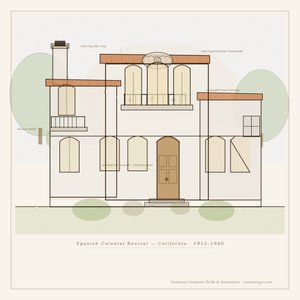
Red clay tile roof. The low-pitched roof covered in warm terracotta clay tiles is the most immediately recognizable feature of the style from the street. Clay tile roofs are not just beautiful — they are designed to resist heat and moisture and are inherently fire resistant. They have proven their longevity across a century of California climate, and well-maintained original clay tile is a genuine asset in a listing.
Thick white stucco walls. The smooth, hand-troweled white or off-white stucco finish is the second signature. But the thickness is not decorative. Thick plaster walls provide natural insulation, thermal mass, and protection from solar heat gain. They are also inherently fire resistant — a feature that has become increasingly relevant and increasingly recognized by buyers in the current California market. This was climate-smart design a century before anyone used that phrase.
Graceful arched doorways and windows. The arch is the visual and structural signature of the style. Arched entry doorways, arched windows, arched colonnades — they evoke the romance of Old World Spain translated for a California setting. Original arched openings with proper proportions are one of the features that buyers respond to most emotionally, and they are among the most difficult and expensive to authentically replicate once lost.
Wrought iron grillwork. Decorative wrought iron on windows, balcony railings, and gates is a defining detail of the style. Scroll patterns, geometric forms, and hand-forged hardware are characteristic. Original ironwork is increasingly difficult to source and replicate authentically, which means intact original grilles and railings carry real value in the current market.
Decorative Talavera tile. Painted decorative tile on floors, stairs, fireplace surrounds, and exterior accent elements is one of the most beloved features of Spanish Revival interiors. Many original tiles came from California potteries including Malibu Pottery, or directly from Mexico. Original Talavera tilework is irreplaceable — once removed, it is gone permanently — and buyers in this segment know it and price their offers accordingly.
The private courtyard. The courtyard is the organizing principle of Spanish Revival living. Inward-facing, shaded, designed for cross-ventilation and outdoor living, it is the feature that most buyers describe when they explain why they fell in love with a Spanish Revival home. The orientation is private by design — simple, undecorated street facades give way to richly detailed interior spaces and courtyard gardens. It is the soul of the style.
Why the Walls Were Engineered for California
Most buyers appreciate that Spanish Revival homes are beautiful. Fewer realize that they were also brilliantly practical — engineered for the California climate long before modern building science existed.
The thick stucco walls provide natural insulation and thermal mass, which means the home stays cooler in the day and warmer at night with less mechanical assistance than a conventionally built home. The low-pitched overhanging roof shades the walls and windows from direct sun. The courtyard plan creates cross-ventilation and shaded outdoor space. The clay tile roof resists heat absorption and is non-combustible.
These features were developed for the hot, intense environments of southern Spain and Mexico, and they translate directly to California. In a state where fire resistance and energy efficiency have become major considerations for buyers and lenders alike, a well-preserved Spanish Revival home offers structural advantages that most new construction does not match.
The Key Architects of Southern California Spanish Revival
George Washington Smith is widely considered the defining residential architect of Spanish Colonial Revival in California. His work — concentrated largely in Santa Barbara — set the standard for high-style Spanish Revival residential design. After the 1925 Santa Barbara earthquake devastated much of the city, Smith's influence shaped the rebuilding program that gave Santa Barbara its unified Spanish character to this day. His most celebrated work, Casa del Herrero, is considered one of the finest examples of Spanish Colonial Revival architecture in America.
Wallace Neff was the architect of choice for Hollywood's Golden Age elite. His residential work across Los Angeles — in Pasadena, Los Feliz, and the hills above Sunset Boulevard — defined the glamorous version of the style. His homes for film stars and studio executives established Spanish Revival as synonymous with California luxury in the 1920s and 1930s, and his buildings remain among the most coveted residential properties in the region.
Reginald Johnson worked extensively across greater Los Angeles and Pasadena. His Spanish Colonial Revival homes combine the formal traditions of the style with a distinctly California sensibility — courtyard plans, deep shading, and an effortless relationship between interior and garden that feels entirely at home in Southern California.
Where to Find Spanish Revival Homes in Our Market
Long Beach
Long Beach has one of the most significant concentrations of Spanish Revival homes in Southern California, protected by city historic district designation across several neighborhoods.
California Heights is Long Beach's largest historic district — approximately 1,500 predominantly Spanish Colonial Revival homes built in the late 1920s. The district is generally bounded by Atlantic Avenue, Bixby Road, Cherry Avenue, and Wardlow Road. The scale and integrity of this district is exceptional, and the historic designation permanently protects the supply of authentic examples.
Belmont Shore and Belmont Heights offer two-story Spanish Revival homes and apartment buildings in the style, with significant concentrations along Ocean Boulevard. Many of the original tile roofs and stucco exteriors have been carefully maintained, and the neighborhood's proximity to the water adds a premium that has held consistently across market cycles.
Bluff Park is one of Long Beach's earliest historic districts, established in 1982, and contains some of the grandest Spanish Revival homes in the city alongside Victorian, Craftsman, and Tudor examples. Located along the ocean bluffs on Ocean Boulevard, the neighborhood combines architectural significance with extraordinary views.
Rose Park and Bluff Heights both include Spanish Revival examples alongside their dominant Craftsman stock, and both carry historic designation that protects the neighborhood character buyers are paying for.
Los Angeles
Spanish Revival was the defining residential style for Los Angeles in the 1920s, and its concentrations are significant across multiple neighborhoods.
Los Feliz and Silver Lake contain some of the finest Spanish Revival residential architecture anywhere in Southern California, including significant work by Wallace Neff and his contemporaries. The hillside streets in both neighborhoods are lined with well-preserved examples that continue to attract design-aware buyers from across the region.
Mid-Wilshire's Carthay Circle neighborhood — now a city historic district — is among the most intact Spanish Revival residential neighborhoods in Los Angeles. South Carthay and PicFair Village are also notable. These neighborhoods were developed specifically in the Spanish Revival style in the 1920s and retain extraordinary cohesion and character.
Whitley Heights and Hollywoodland feature some of the earliest and most dramatic examples of the style, built for the film industry elite who drove the initial wave of Spanish Revival construction in Los Angeles. Pasadena holds significant residential work by Reginald Johnson and other leading practitioners. The Rossmoyne Historic District in Glendale is noted for its Spanish-influenced designs throughout.
Orange County and Beyond
San Clemente was developed from its founding by real estate developer Ole Hanson with Spanish Colonial Revival as the organizing architectural vision for the entire city. It remains one of the most complete expressions of the style as an urban planning concept in California.
Laguna Beach and San Juan Capistrano both have concentrated pockets of Spanish Revival homes, typically at price points that reflect the premium coastal OC market. Santa Barbara, though not in our primary market, deserves mention as the most completely realized Spanish Revival city in America — it adopted the style as its official architecture after the 1925 earthquake and has maintained that character with extraordinary discipline ever since.
Why Original Condition Drives Value
This is the part of Spanish Revival real estate that consistently surprises sellers who have not sold in this segment before: original condition frequently outperforms renovated. Understanding why is essential before you list.
Buyers who seek out Spanish Revival homes are not looking for a contemporary renovation that happens to have a tile roof. They are looking for specific things — the arched doorways in their original proportions, the hand-troweled stucco, the Talavera tile, the wrought iron grillwork, the courtyard plan. A renovation that replaces original ironwork with standard hardware, retiles a fireplace with generic stone, or removes a courtyard wall to create an open plan can destroy precisely what a motivated buyer is willing to pay a premium for.
Conversely, a home that retains its original tilework, its arched windows and doorways, its courtyard, and its authentic street presence — even if it needs cosmetic updating — is offering something genuinely irreplaceable. Buyers in this space understand that and price their offers accordingly.
The practical guidance for sellers: before making any pre-sale improvements, have a detailed conversation about what to preserve and what to update. Original Talavera tile, original ironwork, original arched doors, original stucco — these are the features that drive buyer emotion and justify premium pricing. Replacing them, even with quality materials, almost always reduces value in this buyer pool. Refinishing, restoring, and presenting well is almost always the right strategy. Replacing original features is almost always the wrong one.
Historic District Designation: Your Pricing Floor
Properties in Long Beach's California Heights, Bluff Park, Rose Park, and Belmont Heights carry city historic designation. This protects the architectural character of the neighborhood permanently — owners cannot demolish contributing structures or make significant exterior alterations that diminish historic character without city approval.
For buyers, that protection is not a restriction — it is a guarantee. They are buying into a neighborhood where the character they love cannot be taken away by a neighbor's decision to demolish and rebuild. That permanence is a structural pricing advantage that holds across market cycles, not just when the market is favorable. Every poorly renovated or demolished contributing structure makes the remaining intact examples more valuable.
If you own a Spanish Revival in one of these historic districts, that designation is an asset you should be actively marketing. It is not a burden on the owner — it is confirmation of the permanence of what makes the neighborhood worth buying into.
Thinking About Selling Your Spanish Revival Home?
Spanish Revival homes in Long Beach, Los Angeles, and Orange County attract buyers who are passionate, specific, and educated about the architecture. When they find the right home — authentic, well-preserved, in a neighborhood they have been watching — they move with real conviction and they pay for what they love.
Positioning a Spanish Revival well requires knowing the architecture, knowing the buyer pool, and knowing how to communicate what makes an individual home exceptional. That is a different kind of listing than standard residential inventory, and it deserves a listing agent who understands the difference.
I'm Costanza Genoese Zerbi, RealTrends Verified Broker Associate at eXp Realty, specializing in seller representation across Long Beach, the South Bay, greater Los Angeles, and Orange County. Spanish Revival is one of the styles I know deeply — the neighborhoods, the buyers, and what drives value in this segment.
If you are thinking about selling — or simply want to understand what your home is worth in today's market — I would welcome the conversation.
Costanza Genoese Zerbi & Associates eXp Realty · DRE #01941438 RealTrends Verified · Long Beach · Los Angeles · Orange County costanzagz.com